


PrimaLuna DiaLogue Premium HP Integrated Amplifier
The Finest Tube Integrated Amp you can buy without regard to cost that also shames purpose-built headphone amps costing thousands.

“PrimaLuna’s DiaLogue Premium HP is an integrated amplifier whose sound quality closely approaches that of pairings of reference Class A preamps and power amps.”
— ROBERT DEUTSCH, STEREOPHILE, DECEMBER 2014
The PrimaLuna DiaLogue Premium integrated amplifier has been hailed by experts as the best without regard to cost.
Sam Tellig loved it in his review for Stereophile magazine, giving it a Stereophile Class A Recommended Component rating. Dick Olsher, a world expert on vacuum tube audio stated in his review for The Absolute Sound magazine said “It’s my current benchmark in integrated tube amplifiers.” Merriam-Webster defines benchmark as, “Something that serves as a standard by which others may be measured or judged.”
Because of our designs and proprietary output transformers, the 36 watt DiaLogue Premium has better bass slam than 75 watt tube amps from the biggest names out there. For customers with low efficiency speakers (84-86dB) that like to play their music loud and have a large room, they may want even more power.
We could have easily doubled the output power by simply doing what everybody else does: Run the tubes harder. You’ve seen it. Two power tubes per channel running at the jagged edge, producing 75 or even 100 watts. They also produce unhappy customers, who have to replace tubes every 12 months whereas PrimaLuna customers may go ten years before re-tubing.
A better, though much more expensive way to build, is to keep running the tubes easy, but add four more EL34s. That required enlarging the toroidal power transformer, adding a second Adaptive AutoBias board, and all the circuitry upgrades including the tubes, sockets, Swiss wiring, and Takman resistors.
The result is the HP. One of the most powerful tube integrated amps in the world. Delivering 70 watts per channel from EL34’s, 80 watts from KT88’s, 84 watts from KT120’s, and 96 watts from KT150’s. And like all PrimaLuna amps, the tubes are run so easy you can use it every day and just relax.
Ever since I reviewed PrimaLuna’s ProLogue Premium, for the June 2012 issue, it has been the model I would turn to when I wanted a moderately priced integrated amplifier to try with a new speaker. It never disappointed me, and never seemed outclassed, even when the speaker was the MartinLogan Montis ($10,000/pair). At $2399, the ProLogue Premium to me represents the “sweet spot” for systems in the range of $4000–$10,000 or higher. Although its 35Wpc may not be enough for some speakers (depending on the room and personal preference), I never had any such problem, regardless of whether the speaker had a built-in powered subwoofer (eg, the Montis or the GoldenEar Technology Triton Two) or was a passive design (Wharfedale’s Jade 7 or Focal’s Aria 936). With differences noted depending on whether EL34 or KT88 output tubes were used, the ProLogue Premium delivered sound that was always smooth and musically involving.The first mention I saw of the DiaLogue Premium HP integrated was in a report by Jason Victor Serinus from the 2014 Consumer Electronics Show. He’d been impressed with the sound of the system that featured the Premium HP, describing it as “really nice, with very natural timbres that rival or surpass those of the high-priced spread,” and quoted PrimaLuna’s Kevin Deal: “It’s the best amp we’ve ever done.”
Hmmm. Sounded like something I needed to check out for myself.
Description and Design
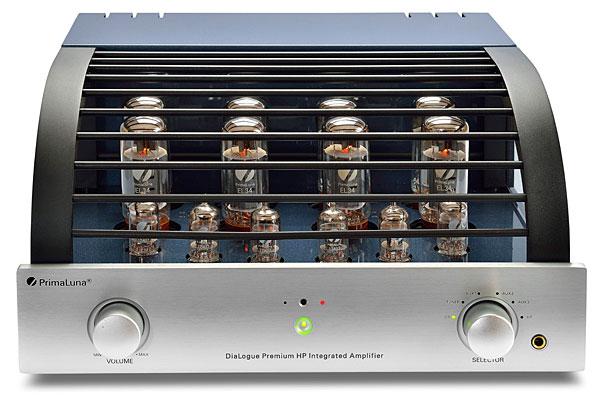
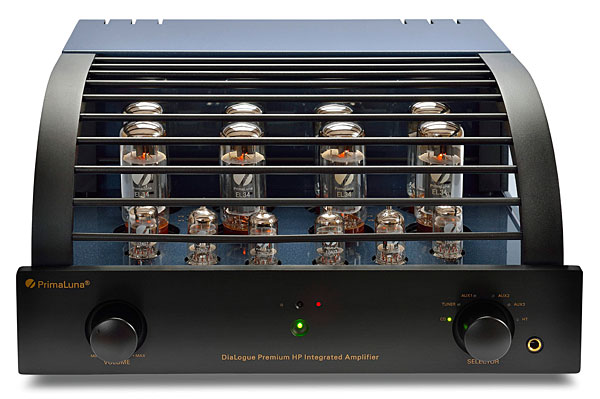
If you gave the DiaLogue Premium HP ($4199) only a brief glance, you might mistake it for a ProLogue Premium. However, placing the two models side by side makes their physical differences obvious: the DiaLogue Premium HP has eight rather than four output tubes, and six rather than four small tubes. And if you were blindfolded and asked to lift each amp—the ultimate blind test—you’d have no difficulty telling them apart. At 46 lbs, the ProLogue Premium is heavy—but the DiaLogue Premium HP is really heavy: 66 lbs. The DiaLogue Premium HP also has a headphone jack, a switch on the right side for selecting between speakers and headphones, and two small indicator lights on the front panel, to signal whether the amp is operating in triode (green) or ultralinear (red) mode.
It would take two pages of small print to describe all of the features of the DiaLogue Premium HP, as it does on PrimaLuna’s website. I won’t duplicate all that information, but here are the salient differences between it and the ProLogue Premium. The DiaLogue Premium HP has:
• Dual Premium Adaptive AutoBias boards, with twice the number of output tubes and the circuitry to support them. Kevin Deal notes that PrimaLuna could have raised the power by running fewer tubes harder, but their more conservative approach results in less wear on the tubes. The Adaptive AutoBias circuitry includes protection, and a Bad Tube LED indicator if a tube fails. PrimaLuna’s implementation of the autobias principle is said to be more sophisticated than that of most manufacturers, who use cathode autobias only.
• All-tube headphone amplifier built in. This is not selected with a simple switch, but with relays that open and close to reduce any interference. I don’t use headphones for serious listening, so I couldn’t verify Deal’s claim that the Premium HP’s headphone amp “will compete with the best,” but I must say I’ve never heard my ancient Grado SR125 ‘phones sound so good.
• AC Offset Killer ensures that the power transformer doesn’t hum, even in areas with bad AC.
• New front-end design, using six 12AU7 tubes instead of four, is said to result in better dynamics and wider bandwidth.
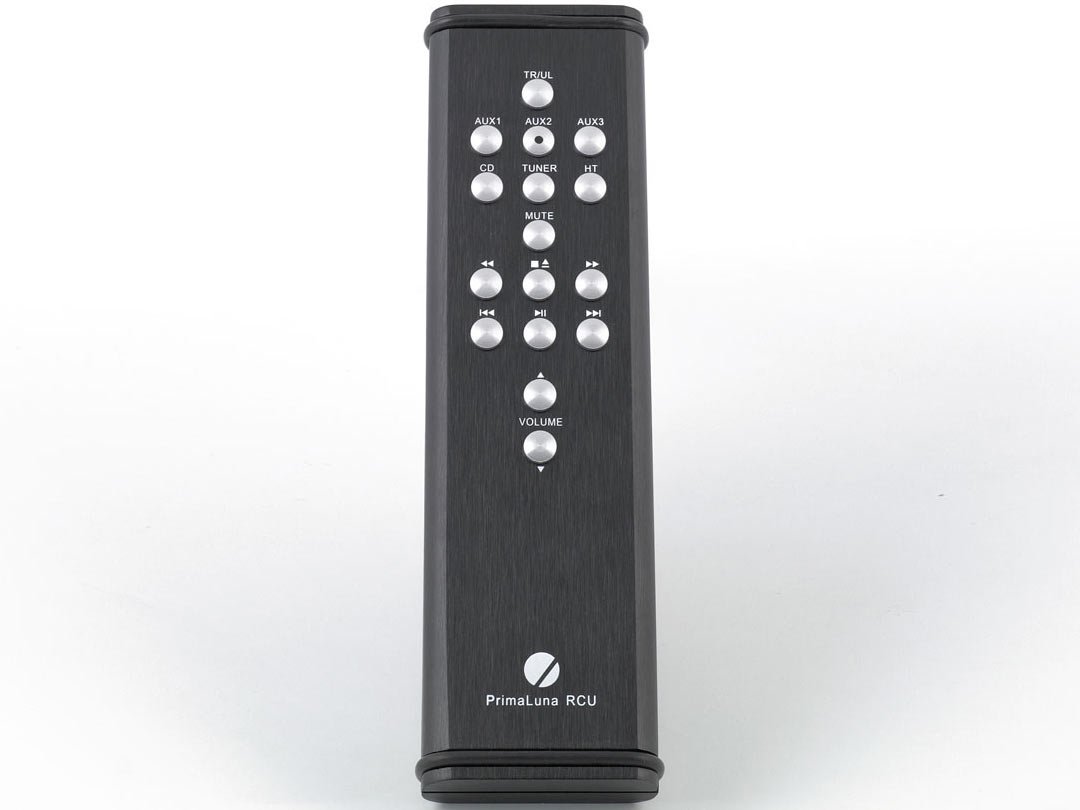
• Triode/ultralinear switching on the fly via remote control.
• Swiss-made wiring of silver-plated copper with Teflon dielectric in all signal paths.
• Audiophile-grade Takman resistors from Japan used in the signal path.
• SCR tinfoil caps in critical positions.
Setup and System
Setting up a solid-state amplifier for review is a pretty simple matter. About the only decision you have to make is whether to use the single-ended or the balanced inputs (if both are available). Then it’s just a matter of swapping the amplifier to be tested for the reference amp, turning on the system, and listening for similarities and differences.
For a tube amplifier, it’s a bit more complicated: You may have to decide what output terminals to use—4, 8, or 16 ohms, (assuming that all of these are provided; the DiaLogue Premium HP omits 16 ohms)—but that’s about it. I had found that I slightly preferred the sound of the ProLogue Premium’s 4 ohm terminals with the Focal Aria 936 speakers, which I also used for this review. I briefly listened to both sets of the DiaLogue Premium HP’s output terminals, and again, the Focals sounded better through the 4 ohm taps, which I used for the rest of my listening.
But this was only the beginning. The DiaLogue Premium HP can use a variety of output tubes, the choice of which can have a major effect on the sound. The Premium HP features autobiasing of output tubes; all you have to do is select, with a rocker switch, the type of tube. (If the switch is in the wrong position, this apparently does no harm; it’s just not optimal in terms of performance.) The amplifier comes with EL34 tubes as standard; in addition, Deal offered to send along whatever other tubes I was interested in trying. I’m not inclined toward tube rolling, but I was curious about the sound with KT120s, a new variant of the KT88 design that has received mostly positive reports. (It’s used in the latest Audio Research amps.) As with any audio product, the praise for the KT120 has not been universal; some have noted that this tube draws more current than KT88, which may, over time, damage an amplifier not designed for it. (McIntosh doesn’t recommend using KT120s in their MC275LE, my reference amplifier.) PrimaLuna, which has a sterling reputation for amplifier reliability, endorses use of the KT120. I assumed they know what they’re doing and asked Deal to send along a set. I report below on the differences I heard.
Nor was that the end of it. Whichever output tubes are used can be used in triode or ultralinear mode. Put all this together, and the DiaLogue Premium HP gives you a choice of, effectively, eight different amplifiers: EL34 triode or ultralinear, and KT120 triode or ultralinear, each with the 4 or 8 ohm output terminals.
My choice of Focal’s Aria 936 speakers was determined by several reasons: 1) at $3995/pair, the Aria 936 is typical of the kind of speaker likely to be paired with a $4199 integrated; 2) having reviewed the Aria 936 in the November 2014 issue, I was very familiar with its sound; 3) the Aria 936 has the transparency and overall sound quality that would allow me to evaluate the quality of the driving amplifier; and 4) I still had the review samples of the Aria on hand, and Audio Plus Services, Focal’s US importer, had no problem with my holding on to them for a while.
Sound
My review sample of the DiaLogue Premium HP review sample was the one that had been demoed at CES, so I figured I didn’t have to worry too much about breaking it in. Still, before doing any serious listening, I played a variety of CDs at various levels, switching willy-nilly between triode and ultralinear, and trying to dissociate my impressions from the analytical/critical part of my brain. Of course, the latter is not really possible, and I quickly came to feel that, as good as the ProLogue Premium is, with the DiaLogue Premium HP PrimaLuna had taken a major step forward in amplifier performance.
To more systematically examine the sound of the DiaLogue Premium HP, I compared it and the ProLogue at matched levels: <0.1dB difference, measured with a voltmeter at the output terminals, using the 1kHz tone of Stereophile‘s first Test CD (Stereophile STPH002-2). Both amps had EL34 tubes installed, and the DiaLogue Premium HP was set to ultralinear, to match the ProLogue Premium.
Some audiophiles hold that at higher power you may gain maximum volume but lose some finesse, and that as long as the amplifier is not driven into clipping, the fewer the tubes, the better the sound. Whatever the merits of this view, it was not confirmed by this comparison. It would be overstating things to say that the DiaLogue Premium HP “blew away” the ProLogue Premium, but it was the clear winner. The most obvious superiority was in the bass. I hadn’t thought of the ProLogue Premium as being deficient in this department, but bass in my usual test tracks, such as “Temple Caves,” from Mickey Hart’s Planet Drum (CD, Rykodisc RCD 10206), extended deeper and was more solid with the DiaLogue Premium HP. And while the ProLogue Premium didn’t seem deficient in allowing the speakers to project a soundstage, with the DiaLogue Premium HP the soundstage was more clearly defined, and the music generally seemed to “breathe” with greater dynamic freedom.
The tonal balance throughout the midrange and highs was very similar through the two amps, the DiaLogue Premium HP perhaps sounding a bit more extended at the top. The ProLogue Premium’s 35Wpc was enough to drive the Focals to levels high enough for me, but my 16′ by 14′ by 7.5′ listening room doesn’t greatly challenge a speaker’s room-filling ability, and while I sometimes listen at what I like to call “realistic” levels, I’m by no means a headbanger. The DiaLogue Premium HP is rated to produce 70Wpc in ultralinear mode with EL34s, and up to 85Wpc with KT120s, thus justifying the “HP” in its name, which PrimaLuna says “stands for High Power . . . and HeadPhones!” If you need more power than the ProLogue Premium, the DiaLogue Premium HP is ready to provide it.
But what about the triode/ultralinear comparison? The ProLogue Premium runs only in ultralinear, so for that amp the question doesn’t apply. For the DiaLogue Premium HP, PrimaLuna’s having put the triode/ultralinear selector button on the remote makes it easy to make this comparison. I’m not a fan of comparisons made on the fly, or switching in the middle of a piece of music; I prefer to listen to a track all the way through (or to the same point in the music), then start it again with the switch in the other position, so that I’m comparing exactly the same selection of music.
Staying with EL34s, ultralinear mode resulted in a sound that was a little more forward, a bit more dynamic than triode mode, and with some recordings seemed to communicate a greater sense of excitement. Triode mode sounded more laid-back, more relaxed. With my usual test piece of Ana Caram’s performance of “Viola Fora de Moda,” from the Chesky Records Jazz Sampler & Audiophile Test Compact Disc, Vol.1 (CD, Chesky JD37), ultralinear mode allowed the various percussion instruments to ring out with greater clarity. Clark Terry’s entrance in “Pennies from Heaven,” from the same disc, was more dramatic: again a bit more forward, triode mode placing his trumpet a bit deeper in the soundstage.
Which was more “natural,” and which a more accurate representation of the music as heard in the recording venue? Search me . . . I was content to listen in either mode, most of the differences being apparent only in direct comparisons. Forced to choose between triode and ultralinear, I’d choose triode—while a little less dynamic and extended at the extremes, it had a smooth musicality and an easy-on-the-ears quality that I found quite beguiling. Of course, with the DiaLogue Premium HP, triode or ultralinear is easily selected using the remote—you can use the mode that sounds better with a given recording, or that better suits your mood. My advice to those not keen on tweaking: Use triode mode as the default, and switch to ultralinear only when you want a bit more oomph.
Tube Rolling
Having satisfied myself that I had a handle on the sound of the EL34-equipped Premium HP in triode and ultralinear modes, it was time to switch tubes. The KT120 is a more macho tube, bigger than the EL34; it requires higher bias, a difference that’s handled by the DiaLogue’s autobias circuitry and the switch that helps optimize the bias for tubes in the KT88/KT120 category.
Compared to the EL34s in triode, the KT120s in triode and at the same level sounded more dramatic, more immediately impressive, with voices more forward—not unlike the EL34s in ultralinear. With recordings such as Ariel Ramirez’s Misa Criolla, conducted by José Luis Ocejo (CD, Philips 420 955-2), KT120s/triode had more slam, with greater dynamic drive. I could hear why this tube has been winning adherents. However, on prolonged listening, switching back and forth with the EL34s at matched levels, my ultimate preference was for the EL34. There was just something right about the sound of this tube in the DiaLogue Premium HP. This preference remained unchanged—in fact, grew stronger—when I switched the Premium HP to KT120/ultralinear. In the Gloria of Misa Criolla, things were fine with José Carreras’s singing, but the choral voices sounded more homogenized, more artificial than in triode. In this selection, the best sound was produced with the EL34s in triode mode.
Finishing Up
The final comparison involved my own reference combination of Convergent Audio Technology SL-1 Renaissance preamplifier ($10,000 with phono stage, $8000 without) and McIntosh Labs MC275LE power amp ($6500, now available in a Mk.VI version for $5500). Each is rated Class A in Stereophile‘s “Recommended Components,” and is widely recognized as a classic.
The CAT SL-1 has a switched-resistor volume control with fairly large steps; I first set this at a suitable level, then matched the DiaLogue Premium HP to the CAT. Levels thus matched, and with the DiaLogue Premium HP in my preferred EL34/triode mode, the similarities were more evident than the differences. Both evinced the smoothness and musicality that tube aficionados appreciate, but without the excessive warmth and rolled-off treble that characterize some tubed gear. Background noise was conspicuous by its absence, and both amps’ power transformers were quiet.
I heard even more transparency and detail from the CAT-Mac combo, but the difference was surprisingly small—and smaller than the difference in price might suggest. Dynamics were comparable, with perhaps just a slight nod to the CAT-Mac.
Conclusion
Built to a high standard, with some very useful features—including Adaptive AutoBias, Bad Tube indicator, on-the-fly switching between triode and ultralinear modes from the remote control, and headphone output—PrimaLuna’s DiaLogue Premium HP is an integrated amplifier whose sound quality closely approaches that of pairings of reference Class A preamps and power amps. The ability to use a variety of output tubes gives the user great flexibility in tailoring the sound to his or her preference. In today’s audio marketplace, $4199 for an integrated amp of the DiaLogue Premium HP’s level of performance represents excellent value. PrimaLuna has another winner.
DiaLogue Premium HP Integrated Specifications
Price $4,399