


PrimaLuna ProLogue Premium Integrated Amplifier
Take your 100 watt amp and put it on Ebay. Or have a yard sale. You’ll never hook it up again.

We don’t want you to compare the ProLogue Premium to an integrated that sells for $2399. That’s too easy.
We want you to compare it to an integrated that sells for $5,000. Compare it for the things that really count. Build quality like point to point wiring. Premium parts like an Alps Blue Velvet Volume control. Custom-wound output transformers for super-wide bandwidth and REAL bass that has punch and follow-through. Engineering like Adaptive AutoBias, Bad Tube Indicator, Super Quiet Relay source selection instead of cheap switches, and SmartWatts which assures you no headaches that for years have been associated with tubes. No longer will you be a slave to worry about how much time you left your amp on. Turn it up. Have fun. Use it every day. All day.
You can compare the sound and it will become immediately apparent. But if that’s not possible, don’t worry. The most well-known experts in audio have done it for you. While most products you read about get good reviews, they don’t get chosen by the experts for their own personal use.
Bob Deutsch, an expert in audio and a well-known senior reviewer at Stereophile magazine, reviewed the ProLogue Premium in 2012. Not only did he give it a great review, he loved it so well he asked if he could continue to use it for writing reviews of top-name loudspeakers. For years now it’s been mentioned in the pages of Stereophile, but in one 2015 review in particular, he really summed it up by saying:
“Ever since I reviewed PrimaLuna’s ProLogue Premium, for the June 2012 issue, it has been the model I turn to when I wanted a moderately priced integrated amplifier to try with a new speaker. It never disappointed me, and never seemed outclassed, even when the speaker was the Martin Logan Montis ($10,000/pair). At $2399, the ProLogue Premium to me represents the “sweet spot” for systems in the range of $4,000-$10,000 or higher.”
— BOB DEUTSCH, STEREOPHILE
Did he say Martin Logan Montis? Those big electrostats? Yup. Just like in solid state, you can have a 100 watt receiver and it doesn’t sound as good as a high quality 50 watt amp. As an experienced audiophile, you probably already know that power has nothing to do with sound quality. Here is proof. Speaker reviews written by a qualified professional using a 36 watt amp. Welcome to the world of educated buyers.
PrimaLuna ProLogue Premium integrated amplifier
Integrated amplifiers are hot. I don’t mean in the literal sense—although having a preamplifier and stereo power amplifier in the same chassis usually results in higher running temperatures—but in the metaphorical one. Once viewed as the type of component that no serious audiophile would consider buying, integrated amps have made a comeback in popularity and prestige. Consider: the October 2006 “Recommended Components” issue of Stereophile listed 29 integrated amps, whereas the October 2011 issue lists 40. Stereophile‘s 2010 Amplification Component of the Year award went to an integrated amp, the Audio Research VSi60, beating out a host of heavy-hitter preamps and power amps. The 2012 Stereophile Buyer’s Guide lists 400 integrateds.What accounts for the renewed popularity of this product category? Cost is certainly a factor, but it’s not the only one. You could buy a separate preamp and power amp for the cost of some integrated amps. I suspect that a major part of the appeal is the desire for simplicity: one box instead of two (or, in the case of monoblock power amps, three) cluttering up the living/listening room, and fewer power cables and interconnects—another cost saving.
When I consider the selection of products for review, I don’t normally look for ones that are in the state-of-the-art, cost-no-object category, but rather ones that promise to offer high sound quality at a moderate price. Based on my experience with the PrimaLuna ProLogue Three preamp and ProLogue Seven power amp (see December 2009, Vol.32 No.12), that pretty much describes PrimaLuna’s design philosophy. So when I read PrimaLuna’s announcement of the ProLogue Premium—”the best integrated amp in its class just got better”—I was keen to check it out.
Description and design
It’s said that an amplification component’s weight can tell you a lot about its quality. Other things being equal, amplifiers that weigh more tend to sound better. Two factors are involved here: transformers and chassis construction. Higher-capacity transformers weigh more and usually result in better sound. Having a more solid chassis helps suppress resonances, which negatively affect sound.
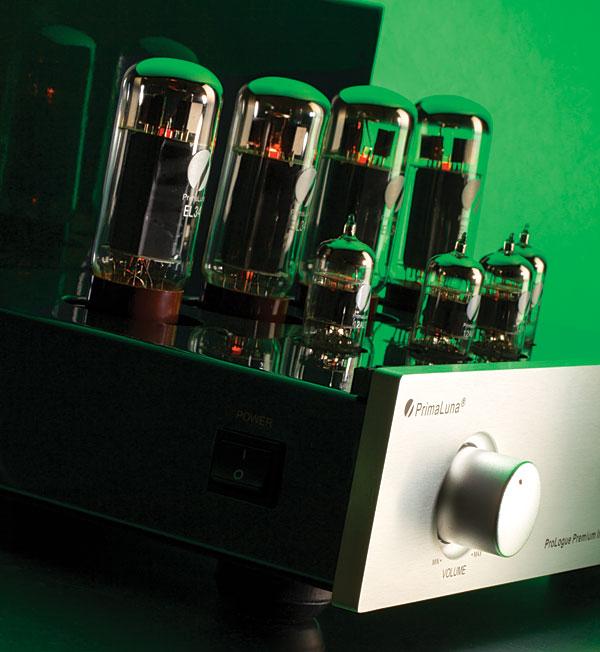
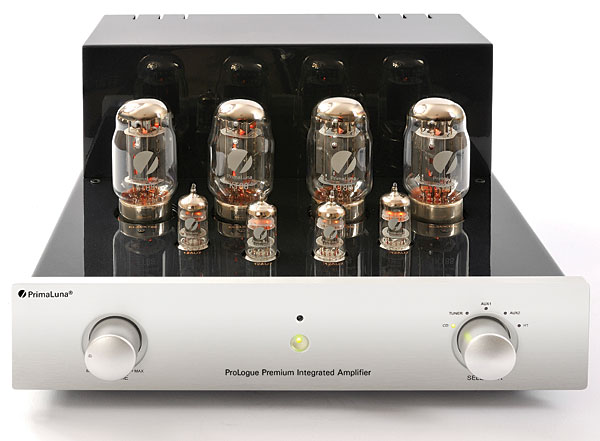
For a 35Wpc integrated amplifier, the ProLogue Premium is surprisingly heavy: 46.3 lbs. The chassis has a very solid feel, and the fit’n’finish is of a quality that suggests a much more expensive piece of equipment. The tubes are covered by a cage that can be easily lifted off rather than requiring a tool to remove it. The front panel has two knobs: one for volume, the other for source selection. There is no balance control. Source selection has an unusual logic: no matter what source you’ve been listening to, when the ProLogue Premium is turned off and then turned on again, the source defaults to CD. On the left side panel, near the front, there’s a rocker switch for power on/off, and on the right side another rocker switch allows selection of bias optimized for EL34 or KT88 power tubes. Accidentally setting this switch to a tube type not installed does no harm; in fact, the user manual suggests that you experiment with the switch position for personal taste. I explored matching/mismatching the tubes and bias switch positions, and preferred the matched positions.
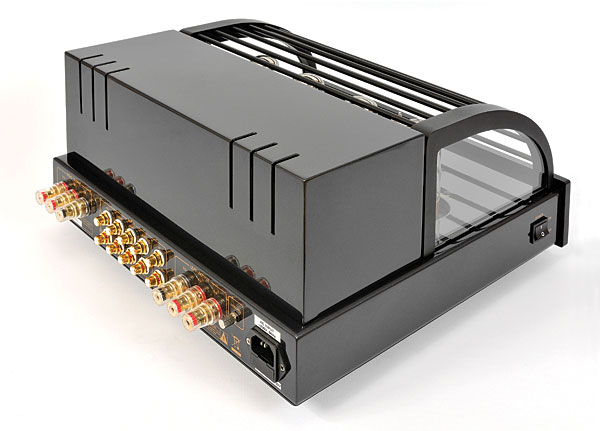
The rear panel sports five pairs of RCA jacks for inputs, one pair labeled HT (for Home Theater). This is not just unity gain, but actually bypasses the preamp section, and allows volume to be controlled by a surround processor/receiver. The ProLogue Premium normally comes with EL34 output tubes, but can also accommodate KT88s, a set of which was included with the review sample. Except as noted, I did my listening with the EL34s. There are connections for speakers with nominal impedances of 4 and 8 ohms. The ProLogue Premium is available with an internal moving-magnet phono stage ($199), but the review sample didn’t include this option.
The ProLogue Premium was designed in Holland by Herman van den Dungen, and, like most audio products these days, it’s manufactured in China. According to Kevin Deal of Upscale Audio and PrimaLuna USA, PrimaLuna’s North American distributor, the engineering of the Premium began with a circuit design in which nothing was taken for granted, and the components selected are of a quality not normally seen in cost-conscious designs. These include:
• Nichicon and Solen polystyrene and tin-foil capacitors
• Alps motorized potentiometer (said to be 10 times the cost of lesser parts)
• toroidal power transformer, manufactured in-house
• capacitor-plus-choke power supply, designed to eliminate both low-frequency ripples and high-frequency hash
• custom-designed output transformers, manufactured in-house
• heavy-gauge, ventilated chassis with a five-coat finish
• construction by hand and point-to-point wiring
The tubes supplied with the ProLogue Premium are SilverLabel, according to Upscale Audio’s classification, and are said to be already “special” compared to standard tubes on the market. Other tubes, including cryogenically treated ones, are available from Upscale.
The ProLogue Premium has a number of specific, trademarked circuits designed to optimize performance and prevent damage to the amplifier in the event of a malfunction:
• Adaptive AutoBias (AAB) monitors and adjusts bias constantly. AAB was present in previous PrimaLuna amplifiers, but the latest version is said to include more extended output-stage protection circuitry, to safeguard the output transformers, resistors, and high-voltage power supply in case a tube fails.
• Bad Tube Indicator (BTI) is what PrimaLuna calls the red LED next to each output tube, though BTI is not quite what its name implies. A lit BTI LED indicates that the tube is drawing more power than it should; however, this condition may be only temporary, and not necessarily indicate a bad tube. If the BTI comes on, you’re advised to turn off the ProLogue Premium, wait a few minutes, and turn it on again. If no BTI LEDs light up, you’re fine. It’s only when the indicator stays on that the cause is likely a bad tube, which must then be replaced. During the review period, there were a few instances of a BTI coming on, but each time, turning the amplifier off and then on again fixed the problem.
• Power Transformer Protection (PTP) is a thermal switch built into the AC transformer. If the internal temperature gets too high, the AC is switched off automatically, coming back on again when the problem is resolved. This never happened during the review period.
• Output Transformer Protection (OTP) protects the output transformers from high-voltage transients. Power in my system is supplied by a PS Audio PerfectWave Power Plant 5, which is designed to protect against transients of this sort; in any case, there were no problems in this area.
• SoftStart is yet another protection circuit, designed to extend the life of sensitive components and reduce the chance of tube failure from thermal shock.
The basic design of the ProLogue Premium follows tried-and-true principles: the output stage runs in Ultralinear mode, and tubes run well below their maximum ratings. Like other products in PrimaLuna’s Premium range, the ProLogue uses double 12AU7s in each channel rather than the earlier combination of 12AX7 and 12AU7. This is said to result in much lower distortion in the first stage.
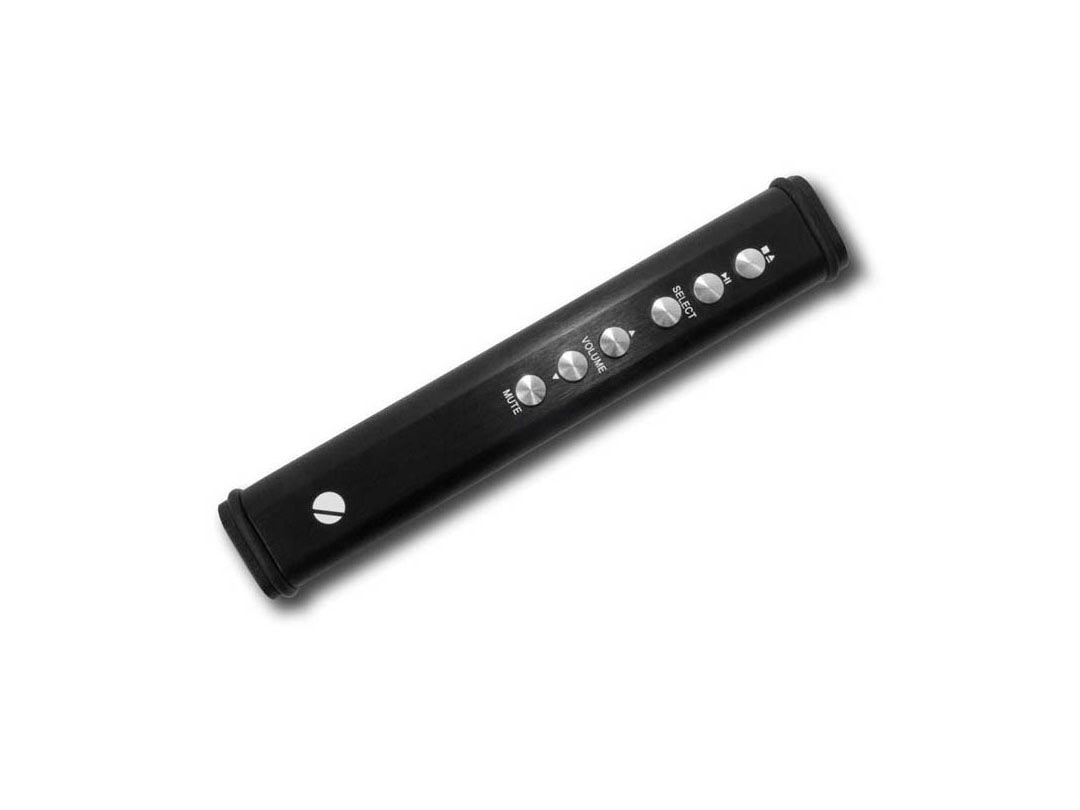
The ProLogue Premium includes a solidly built remote control that also controls the basic functions of PrimaLuna CD players. I found the remote to work extremely well to set the desired volume: a very brief depression of the Up or Down button resulted in a correspondingly minimal change in volume, with no overshoot. Like most remotes, this one has buttons of identical shape and size. Since there are only six buttons, remembering the most frequently used ones, Up/Down/Mute, is not that difficult, but I wish they’d made the Up and Down buttons differently shaped or sized from the others, so that they could be identified by touch.
Setup
Setting up an integrated amp like the ProLogue Premium should be pretty straightforward: connect the source interconnects, speaker cables, and, last, the power cord; make sure the volume control is turned all the way down; turn it on.
Sounds simple enough, but I ran into a problem at the very first stage: plugging in the interconnects from the CD player. The ProLogue Premium’s RCA jacks have plastic covers on them, and I had a difficult time trying to remove the ones over the CD input pair. (The user’s manual makes no reference to these protective covers; they may have been a late addition.) Pulling on them didn’t seem to work, so I started twisting one of them—and then I felt it give, and the entire input jack started turning! Not good—I’d inadvertently broken the internal connection to the CD input jacks. To repair the damage, with Kevin Deal’s approval, I engaged the services of a highly experienced audio technician, Roger Sherman, who came to my home and was able to resolder the connection without difficulty. I eventually found out that there’s a trick to removing the protective caps. There’s a part that provides for a grip (it was facing the bottom, so I didn’t see it); once you take hold of that, you can easily pull the cover off. This problem solved—and both channels of the CD input working properly—I was ready to do some listening.
According to the folks who view measured electrical performance as the only criterion for the assessment of an amplifier, once an amplifier’s internal components have reached operating temperature, the amplifier is performing as well as it’s ever going to perform: “break-in” and “warm-up” (beyond a minute or so) are simply myths.
But most audiophiles and manufacturers of audiophile equipment know that break-in and warm-up phenomena are real, and that amplifiers vary in these characteristics. In discussing the effect of replacing tubes, PrimaLuna notes that “break-in yields improvements.” In the case of the ProLogue Premium, I found that over a period of several weeks, with the amplifier on 9–10 hours a day and playing music 3–4 hours a day (I leave the CD player on all the time), there was an improvement: the music sounded more detailed, and somehow more “relaxed” and free-flowing. It also seemed to me that, playing music each day for several hours, there was a similar sonic improvement, suggesting a warm-up effect beyond the few minutes it takes the tubes to reach their normal operating temperature. I noted these effects while using the Avantgarde Uno Nano speakers; the warm-up effect was also apparent with the GoldenEar Triton Twos. I decided to evaluate it in a more systematic way.
Sound: Take One
Listening more critically, comparing the ProLogue Premium with the CAT-Audiopax at matched levels, I heard some differences. With the CAT-Audiopax, the sound was more convincingly three-dimensional, with more “air” around voices and instruments; the highs were more detailed without becoming overly bright; and it was easier to follow the music’s subtle ebb and flow. These differences—apparent when I was wearing my “sharpener” hat—are to be expected, given the price difference. People who have $18,000 to spend on speakers like the Avantgarde Uno Nanos can usually afford to spend more than $2299 on an integrated amp, and probably should, to get the most from their speakers. However, if you’ve picked up a used pair of Uno Nanos (or Unos or Duos) at a bargain price and don’t have a lot of money left over, the ProLogue Premium would give you maybe 90% of what these speakers are capable of—and outside of an A/B comparison, you wouldn’t know what you were missing.
Sound: In the Real World
The Avantgarde Uno Nano is a rare bird: ultra-high efficiency, horn-loaded midrange and tweeter, powered subwoofer. Evaluating an amplifier with this speaker, while useful, doesn’t tell you how the amp will fare with more conventional speakers—and, of course, there’s a major mismatch in price. Keeping these factors in mind, I spent most of my ProLogue Premium reviewing time using speakers that are less exotic in design and provide a better price match: the GoldenEar Triton Twos.
The Triton Two is one of my favorite speakers: a floorstanding three-way that sells for $2999/pair, whose sound quality comfortably exceeds what is normally expected at this price level. Like the Uno Nano, the Triton Two incorporates a powered subwoofer. Its claimed sensitivity, confirmed by John Atkinson’s measurements, is 91dB—somewhat higher than the norm, but much lower than the Uno Nano’s. JA also noted that “the speaker will not be too difficult for the partnering amplifier to drive.”
The combination of the Triton Twos and the ProLogue Premium proved particularly synergistic—it was as if each designer had used the other’s speaker to fine-tune the sound of his own. The speakers sounded good through the ProLogue Premium’s 8 ohm connectors, and even better—more dynamic, more “present”—through the 4 ohm taps.
Comparing the ProLogue Premium to the Audiopax 88 Mk.II and the Simaudio W-7, each driven by the CAT SL-1 Renaissance preamp, there were areas of performance in which each of these high-end references sounded superior.
The Audiopax’s major area of superiority was its ability to present recordings that normally sound a bit harsh in a way that made me think that the recording sounded better than I’d realized. Come Fly With Me (CD, Capitol CDP 7 48469 2) catches Frank Sinatra at his confident best, with Billy May’s arrangements and musical direction providing perfect support, but there’s no getting around the fact that the massed strings have a certain edge, whether from limitations of the 1957 recording technology or the digital transfer. This edge was less noticeable through the CAT-Audiopax combo than through the ProLogue Premium.
The Moon W-7 had more of this edge than the ProLogue Premium—and much more than the Audiopax—but it beat both tubed amps in its sense of power and dynamics, had more extended bass, and was able to drive the speakers to a higher level without strain. The sonic character of the ProLogue Premium was in between the Audiopax and the Moon W-7. At times, listening to the system with the Audiopax in it, I thought, Yes, this is the way it’s supposed to sound—and then I began to get the feeling that the sound was too smooth, too liquid. Similarly, when listening to the system through the Moon W-7, I was impressed with the clarity, definition, and dynamic swing—Yes, this is more like the real thing. Then my critical self again reared its head, and I began to feel that the sound was a bit on the aggressive side, pushing the music toward me rather than drawing me into it. And whenever I switched over to the ProLogue Premium, I had the feeling that here was an amplifier-speaker combination that just “clicked.” For an integrated amplifier that costs a mere fraction of these high-end references, this is remarkable performance.
The ProLogue Premium’s Home Theater input bypasses the preamp section, including the volume control. I did a trial using this input, connecting it to the output of the CAT preamp, with the Ayre Acoustics CX-7eMP CD player connected to the CAT preamp’s input. In this setup—in which I used the ProLogue Premium as only a power amp—I could evaluate the contribution of the ProLogue’s preamp section to the sound.
When I compared the ProLogue Premium with the CD-player interconnects plugged directly into its CD inputs vs into one of the CAT’s line-level inputs, the output of the CAT driving the ProLogue’s amp section directly, the differences were not great but were significant. The tonal balance remained much the same, but with the CAT doing the preamplification there was a definite improvement in what I might call finesse—the percussion instruments in track 3 of the Chesky test CD were clearer and more distinct, but also more delicate, and with no added edge or harshness. Double-bass notes were also more clearly defined. Bass drums had greater weight. Given that the CAT SL-1 Renaissance is widely recognized as one of the world’s best preamps, and costs nearly four times as much as the ProLogue, the fact that it sounded better than the Premium’s preamp section shouldn’t come as a surprise. The real surprise is how close the ProLogue’s preamp section came to the sound of the reference-quality CAT SL-1.
Sound: More Exotica
As I neared the end of my time with the ProLogue Premium, a pair of MartinLogan Montis speakers arrived for review. The Montis ($10,000/pair) features an electrostatic midrange/tweeter mated to a powered woofer. Electrostatics are notorious for presenting a difficult load to amplifiers (the specifications for the Montis state that its impedance at 20kHz drops to 0.52 ohm), but having a woofer with its own amplifier should help.
Since the ProLogue Premium was the first amplifier I used with the Montis, I had no background to draw on to determine if, in fact, the ProLogue was a good match for this speaker, but it sounded pretty good to me. Mark Aling of Paradigm/MartinLogan, who helped me set up the Montises, and who has heard them in other contexts, indicated that he was pleased with the sound. Whatever the effect of the low-impedance load in the high treble, the ProLogue Premium didn’t seem fazed by it—perhaps because there’s so little musical content up there. A test with the CAT-Audiopax quickly revealed that this was not a good combination: the treble was much softer than ideal, and the amp ran out of steam at higher—but not room-shaking—levels. The ProLogue Premium fared better; the highs were still a bit subdued, but to a lesser extent.
As mentioned earlier in the review, my listening throughout was with the EL34 output tubes. When I had the GoldenEar Triton Twos in the system, I did a brief trial using the KT88s, and I much preferred the EL34s’ more laid-back sound. The ProLogue Premium’s rated output using the EL34s is 35Wpc, whereas with the KT88s it’s 40Wpc—a difference small enough that I thought it would be inconsequential. Nevertheless, I swapped out the EL34s for KT88s (remembering to change the position of the bias switch), and, whether because of the minor power difference or other reasons, I preferred the sound with the KT88s. Unlike with the Triton Two, where the sound with the KT88s was a bit on the brash side, with the Montis the sound was tonally better balanced than with the EL34s, with more extended highs and a more dynamically lively presentation.

My last comparison involving the Montis and the KT88-equipped ProLogue Premium involved changing from the 4 ohm to the 8 ohm speaker connectors. The Montis is rated at 4 ohms, but is described as being “compatible with 4, 6, or 8 ohm rated amplifiers.” I fully expected that the 4 ohm output would produce better results, as it had with the Triton Two. Not so! The sound using the 8 ohm connectors was more open and better focused.
It just goes to show you that in audio there’s little that you can take for granted. With the KT88s and the 8 ohm speaker connectors, the combination of ProLogue Premium and MartinLogan Montis became a more-than-credible match, despite the major disparity in their prices.
Conclusions and System Building
Built to a high standard, the PrimaLuna ProLogue Premium offers outstanding sound quality at a very reasonable price. In my listening tests, it combined well with speakers both conventional and exotic, and gave high-end references more than a run for their money.
Audiophiles often complain about how expensive this hobby has become—and not without justification. In apportioning the job of reporting on amplification components at the 2012 Consumer Electronics Show, Larry Greenhill and Stephen Mejias set $5000 as the dividing line between “inexpensive” and “expensive.” (Stephen tells me that he would have liked to set the cutoff at $1000, but there simply wasn’t enough at CES below that price, which would have led to an unequal division of labor.) The 2012 Stereophile Buyer’s Guide lists 29 integrated amps costing $10,000 or more, including one that comes in at a cool $100,000. Is this sheer madness?
What tends to be forgotten during the expressions of outrage about high prices is that if you ignore equipment at “crazy prices”—and, of course, each of us has his or her own idea of exactly where “craziness” begins—ours is a great age for the cost-conscious audiophile. If you do your homework on what’s available, read the reviews, and visit dealers who make a point of offering their customers value, you can assemble a system for a reasonable price that—with attention paid to component matching and setup—can offer sound quality that comes close to the cost-no-object.
The ProLogue Premium would be an excellent component around which to start assembling such a system. I found it combined well with speakers as disparate as the Avantgarde Uno Nano, GoldenEar Triton Two, and MartinLogan Montis. The ProLogue Premium also allows some fine-tuning to match the speakers: there’s a choice of output terminals (8 or 4 ohms), switchable power-tube bias, and a choice of power tubes (EL34 or KT88).
Playing the system-building game, first with an emphasis on keeping the total system price down, I would combine the ProLogue Premium ($2299) with the Marantz CD5004 CD player ($350), and with something like the Dynaudio Excite X12 ($1200/pair) or PSB Imagine B ($1100/pair) speakers, plus some entry-level cables from AudioQuest or Kimber Kable. At a total price of around $4000—plus another $400 for a Pro-Ject Debut III turntable and $199 for the PrimaLuna phono stage to get you into the world of vinyl—you’d have a musically satisfying system that represents outstanding value.
At the next system price level, the obvious partnering loudspeaker for the ProLogue Premium is the GoldenEar Triton Two. Keeping everything else the same, you’d have a system price of about $6000. Further improvements could come from upgrading the digital source (I’d first check out Oppo’s BDP-95 SACD/CD player, for $1000)—and consider getting better cables and a power-line conditioner. For a total price well under $8000, this system could easily compete with the typical rig costing $20,000.
Yes, this is a great time to be an audiophile.
ProLogue Premium HP Integrated Specifications
Price $2,399