


PrimaLuna DiaLogue Premium Integrated Amplifier
Don’t buy good. Buy perfect. Iconic. State of the art. Something that will still be relevant ten years from now and that is built to last a lifetime.

Thinking of buying an amp because of good reviews? Every product, no matter what, gets some good reviews. So how do you know if it’s simply good or world-class?
The answer is simple- When a magazine reviewer spends their own money to buy it for themselves! Many reviewers have done just that because every PrimaLuna reviewed has a Stereophile Class A rating. Class A is defined as “Best attainable sound for a component of it’s kind, almost without practical considerations” with practical considerations meaning at any price. The Absolute Sound’s Dick Olsher is possibly the most experienced and technically adept writer on staff when it comes to tube amplification. He declared “It is my current benchmark in integrated tube amplifiers,” resulting in a 2014 Editor’s Choice Award.
Sure it looks good. But that should never be a reason to buy. Don’t be fooled by overpriced name brands and lofty descriptions that cover up mediocre build quality. Do you want an $8000 integrated amp weighing only 36lbs with one printed circuit board, no-name parts inside, and a push button chip volume control? Or a $3399 integrated weighing 64lbs, hand made with Swiss point to point wiring and the finest exotic parts, and the most advanced technology found in any tube amplifier? Any audiophile who is also an electrical engineer would know instantly.
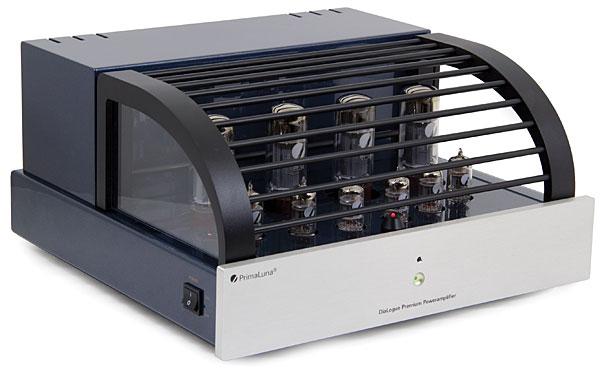
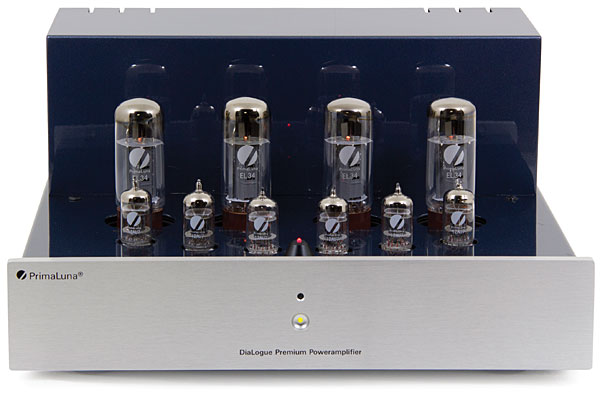
PrimaLuna DiaLogue Premium power amplifier
The road to hell is paved with good inventions: clever ideas that appear, in hindsight, motivated more by a desire to sell clever ideas than to make musically superior products.
The DiaLogue tube amplifiers from PrimaLuna have, at their heart, a clever idea of their own: an output circuit that is user-switchable between triode operation, in which the screen grid of a tetrode or pentode power tube is defeated by means of connection to the tube’s anode; and Ultralinear operation, in which the screen grid of a tetrode or pentode carries a portion of the AC music signal, supplied by a tap on the output-transformer primary, in a feedback-like effort to reduce distortion and increase power. Fans of the former often report a sweeter, more tubey sound, while fans of the latter report a tighter, more detailed, more timbrally neutral sound. Audio enthusiasts are given to reporting any number of things.
Here’s the difference between PrimaLuna’s clever invention and all of those self-centering turntable platters and “sonic hologram” generators: None of the latter really caught on in the long run, their makers having moved on to ever more newsworthy gewgaws, while PrimaLuna’s Triode/Ultralinear circuitry has endured since 2006—and has apparently succeeded in the marketplace. (The company itself got started in 2000.) It has also spread to even more products in the PrimaLuna line, the most recent being the DiaLogue Premium amplifier ($3199), which offers 25Wpc in triode mode, 42Wpc in Ultralinear.
Description
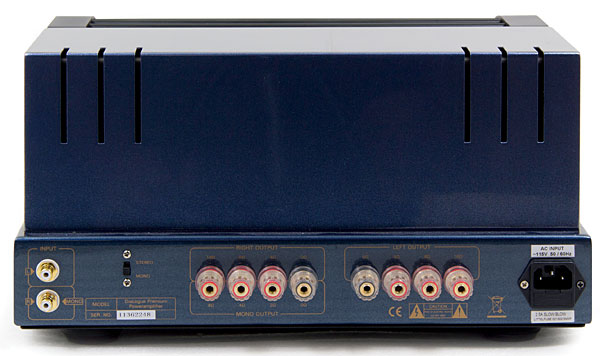
The PrimaLuna DiaLogue Premium has more than one clever trick up its sleeve. Flip the rocker switch on the right side of its chassis and this erstwhile EL34 amplifier can now accept power tubes from the KT88/KT120 family of pentodes. Flip a switch on the rear panel and this stereo amplifier is now strapped for use as a higher-powered monoblock, after which you have a choice of buying one more DiaLogue Premium or discarding one of your loudspeakers. (You know which route I’d go.) Sit back and ignore both of those switches and the DiaLogue Premium still offers: an LED-based Bad Tube Indicator system for the output tubes; a Power Transformer Protection circuit; an Output Transformer Protection circuit; and an AC Offset Killer circuit intended to eliminate hum and promote more silent spaces between the notes. Choices!
Enduring in the DiaLogue Premium amplifier is an updated version of a design innovation that has, from day one, characterized all of PrimaLuna’s amplifiers: their Adaptive AutoBias circuit. In contrast with the traditional application of the term, whereby an auto-bias circuit is one in which the signal grid automatically takes on a negative bias relative to the cathode simply by using a resistor to raise the latter above ground, PrimaLuna’s Adaptive AutoBias keeps the cathode at or near ground, and applies to the signal grid a negative voltage that is subject to continual change, in response to amplifier demands and the aging of the power tubes (footnote 1).
Back to the Triode/Ultralinear choice: In the last PrimaLuna amp I reviewed, the DiaLogue Seven monoblock (see Stereophile, January 2010), chief designer Herman van den Dungen and his engineering team effected that switching capability by putting two separate output transformers into each mono amplifier. Yet in a stereo amplifier such as the DiaLogue Premium, a total of five large transformers—two Ultralinear output transformers, two triode output transformers, and one sizable power transformer—would add to the product unwanted weight, bulk, and electromagnetic fields. Thus the DiaLogue Premium has only a single stereo pair of output transformers, the primary sides of which are bordered by small circuit boards containing relays and transistors, presumably to reconfigure, on the fly, the various primary taps.
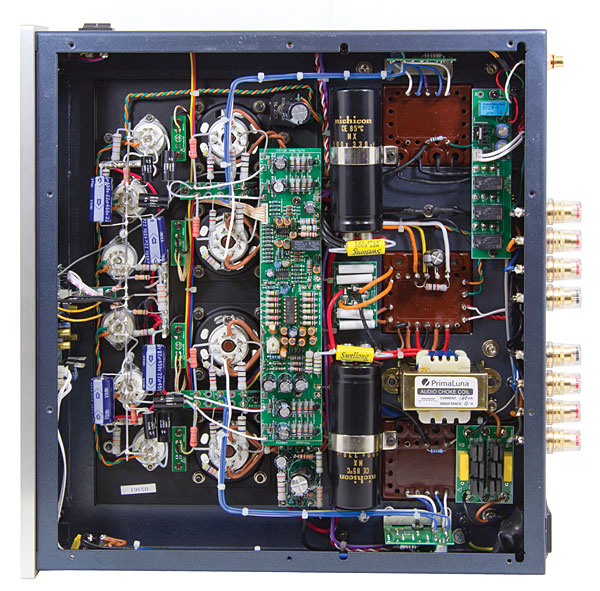
Indeed, small circuit boards stuffed with relays and transistors are the order of the day here—the AC Offset Killer board alone has a full dozen transistors—yet these are not in the signal path, which itself is executed with conspicuously neat point-to-point wiring and such high-quality parts as Solen capacitors, Takman resistors, and robust ceramic terminal strips. The DiaLogue Premium has three 12AU7 small-signal tubes per channel, including voltage-gain stages and a long-tailed pair for phase inversion. The power supply uses silicon devices for rectification—individual diodes for the rail, a full-wave bridge rectifier for the heaters—followed by a pi filter incorporating two large Nichicon reservoir caps and a neat proprietary choke. As I’ve found is typical of PrimaLuna, whose products are designed in the Netherlands and assembled in China, the build quality of the DiaLogue Premium’s circuitry and casework is excellent.
Installation and setup
One could easily go overboard writing about the PrimaLuna DiaLogue Premium: Here’s how it sounded with EL34s in triode mode, and the same tube in Ultralinear mode, and the KT88 in triode, and . . .
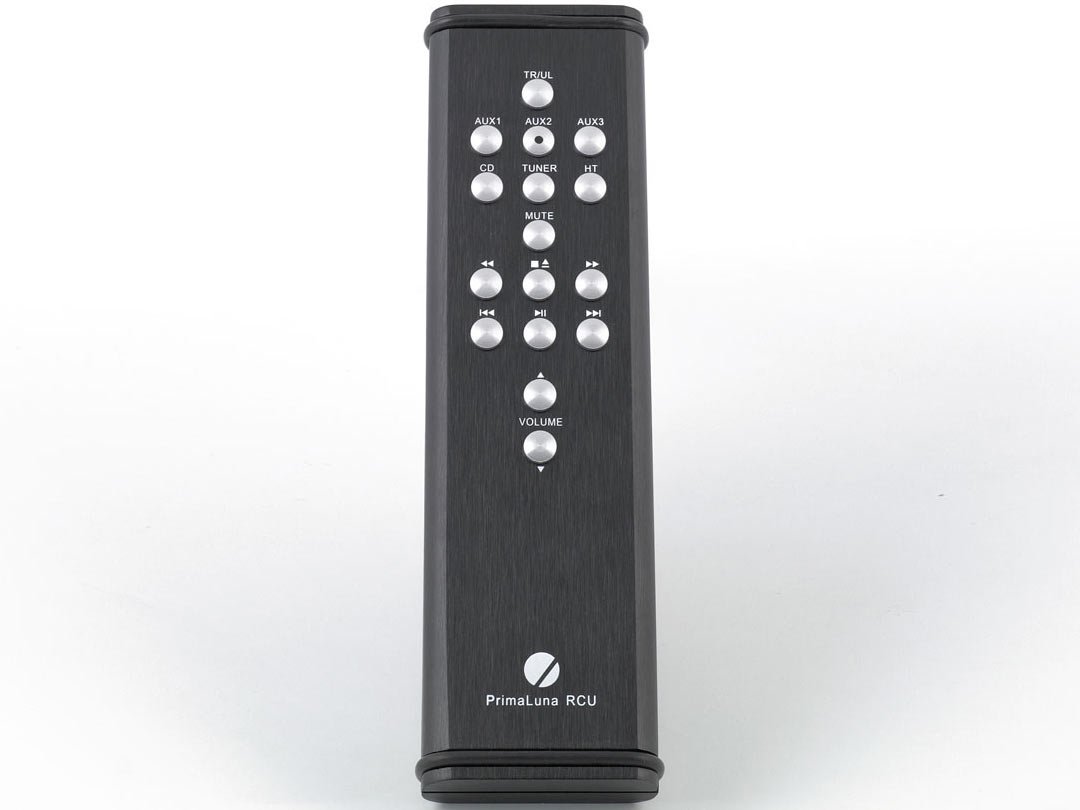
Because the amp is supplied with EL34 power tetrodes as standard, that’s where I started. And because the review sample, as shipped, was set to Ultralinear mode, and because the remote handset, which controls only that function, arrived with a dead 2032 3V battery, and because that function can’t be controlled from the amp itself . . . well, that, too, is where I started.
I enjoyed the detailed and pleasantly punchy sound of the Premium in EL34 Ultralinear mode. But when I refreshed the handset’s battery and restored the Premium’s switchability, I was even more impressed with the amplifier’s Triode-mode performance, which, through my very sensitive Altec Valencia speakers, had a more pleasing and more “organic” bottom-to-top balance of performance, while appearing to sacrifice nothing in terms of detail or temporal accuracy.
And then, when I replaced the Premium’s stock, PrimaLuna-branded EL34 tubes with the Russian-made Tung-Sol KT120s sent to me, for trial, by PrimaLuna distributor Kevin Deal, I was even more impressed with those—an $80 option at time of purchase. I also preferred to use the KT120s in Triode mode.
To confirm those impressions, I did a considerable amount of switching, back and forth, of tubes and switches. And there came a day when I discovered that I’d spent a few hours listening with KT120 power pentodes, but with the tube-selector switch—which controls bias voltage—set for EL34. After making the correction, I noticed that not only was the switch’s effect subtle, but that I actually enjoyed the sound of the KT120 tubes set for EL34 bias.
Curious, I opened up the DiaLogue Premium and made a few cursory measurements, at which time I discovered that the position of the selector switch makes a difference of less than 2V for the same tube: –54.6V when set for KT120s vs –56.4V when set for EL34s. (I suppose one might see more or less of a voltage difference when changes in switch position are accompanied by changes in power tubes, given that different tubes can draw different amounts of current.)
Be that as it may: The reader should note that all of the listening observations that follow were based on the DiaLogue Premium used with KT120 power tubes operating in Triode mode, with the tube-selector switch set for KT88/KT120.
A couple of notes regarding the making of loudspeaker connections: According to Kevin Deal, the DiaLogue Premium does not invert absolute signal polarity. I listened for that anyway, and found that, for whatever reason—perhaps nothing more than my choices of music?—this was one of those amplifiers through which changes in polarity were exceedingly difficult to hear. I also experimented with different loudspeaker-output taps. The DiaLogue Premium offers separate terminals for 4, 8, and 16 ohms; although I relied on the 16-ohm terminals for my 16-ohm Altecs, their sound from the 8-ohm taps was also appealing—and, at times, seemed actually to provide a somewhat larger sense of scale. Choices!
One final (I promise) note: Although a specification isn’t given, the PrimaLuna DiaLogue Premium appeared, in my system, to offer gain so much higher than the norm that I was forced to use my Shindo Laboratory Masseto preamplifier, itself no gain slouch, with its volume control set near the bottom of its range—and the bottom of the range of most stereo potentiometers is not known for good channel-to-channel tracking. During my listening, I did note that the left channel seemed slightly louder than the right, but I attributed that to the preamp’s volume pot; in the event the amp was also at fault, that will show up in John Atkinson’s measurements.
Listening
After a longer-than-average running-in —itself occasioned by the rediscovery, behind the television set, of the remote handset for my Sony SACD/CD player, thus enabling me to once again use the SCD-777’s Repeat function—I began my more intensive listening with simple music: the wonderful-sounding, monophonic A Collection of Favorites by the Carter Family (LP, Stetson HAT 3022); the eponymous, brilliant, groundbreaking, and artistically audacious if sonically brittle debut album of Loudon Wainwright III (LP, Atlantic SD 8260); the grainy but otherwise okay-sounding Teaser and the Firecat, by Cat Stevens (LP, Island ILPS9154); and various selections from the Nick Drake catalog, on Island and Hannibal. All sounded fine through the PrimaLuna DiaLogue Premium, with appropriate scale and believable vocal and instrumental timbres.
But the Carter Family album was served best of all. Here, the DiaLogue Premium impressed me by nailing the distinctive and historically influential sound of guitarist Maybelle Carter’s pick attack, not to mention the charmingly unaffected (and at times downright flat) sound of her voice.
That said, the DiaLogue Premium was at its best with music of size, scale, drama, and complexity: It was, indeed, a bigger-is-better kind of amplifier. The PrimaLuna amazed and delighted me throughout the good if not quite top-shelf recording of Wagner’s Das Rheingold, recorded in 1993 by Christoph von Dohnányi, the Cleveland Orchestra, and a cast whose greatest standout was Peter Schreier’s Mime (2 CDs, Decca 443 690-2). Besides allowing the music to retain an appropriate sense of scale, and endowing everything from plucked strings to violently hammered anvils with a believable sense of force, the PrimaLuna amp allowed voices to sound unusually warm and present, while at the same time reproducing nuances of pitch and inflection with uncommonly good clarity.
A welcome letter from reader Milo Shepherdson reminded me how much I enjoy Ike Quebec’s Soul Samba (Blue Note/Classic ST-84114)—and how I botched my reference to it in the November 2013 “Listening,” imagining a piano where there is none. In fact, it was during this casual bit of listening that the excellence of the DiaLogue Premium really dawned on me. The amp gave my Shindo Corton-Charlemagne monoblocks a real run for their money on every track of this record, the PrimaLuna caressing each number with a very full and rich yet musically detailed and explicit presentation. Quebec’s tenor-sax tone was perfect and big, yet the PrimaLuna thought the real star was guitarist Kenny Burrell, whose solos it presented with exceptional, world-class touch: I have never heard his playing, or indeed this album in its entirety, sound better.
The recording by the Ensemble de Solistes des Concerts Lamoureux of Darius Milhaud’s Les Quatre Saisons, led by the composer (LP, Philips 6504 111), is perhaps one of the best-sounding LPs in my collection: open, clear, and dramatic, with good tonal balance, realistically weighty bass, and remarkable spatial depth; it is also a recording of sublimely melodic yet unmistakably modern—at times, somewhat angular—music. The PrimaLuna honored every one of those aspects. The entrance, in the first movement—Printemps, of course—of the double bass was reproduced with virtually peerless tension and impact, and believable note attacks and decays. Strings had realistic bite and not a sliver more, and the PrimaLuna amp endowed—or, if you wish, allowed—strings of notes to have a very believable, engaging sense of momentum and flow.
During the PrimaLuna’s time in my system, I also made note of its performance on those many records that fall short of the sonic ideal. In every such case, the DiaLogue Premium let those recordings retain their characteristic signatures—dark sounded dark, bright sounded bright, and so forth—while reproducing them with all due melodic and rhythmic realism. One example was Joanna Newsom’s sort-of-live album from 2007, Joanna Newsom and the Ys Street Band (EP, Drag City DC336), an unrepentantly shouty and overly forward recording that’s also frustratingly murky: frustrating because these rearrangements—for musical saw, tambura, accordion, and drums, alongside Newsom’s usual harp—of mostly familiar Newsom songs are quite engaging on those occasions when the musical details emerge above the sonic mud and glare.
As with the above-mentioned Carter Family collection, the PrimaLuna did a consistently fine job of capturing the solidity, substance, and impact of every great mono recording I played through it. The most notable example came one evening as I worked my way through the 1963 boxed set Wilhelm Furtwängler: In Memoriam (LP, Deutsche Grammophon KL.27/31). Although I have yet to experience all of Furtwängler’s recordings, it seems he was seldom truly well served by sound engineers, making all the more conspicuous his few really great-sounding sessions—including his 1953 performance, with the Berlin Philharmonic and soloist Wolfgang Schneiderhan, of the Beethoven Violin Concerto. To hear it through the PrimaLuna was to hear a superb amplifier magnify and exploit the strengths of a transcendent music recording. Nor was the DiaLogue Premium immune to the tactile, substantial, richly colorful charms of my favorite 78s, including Suite 2 from Prokofiev’s Romeo and Juliet, lustily played by the Moscow State Philharmonic Orchestra and conducted by the composer (shellac, Disc Company of America2 754); and the Prelude to Wagner’s Parsifal, performed by Serge Koussevitsky and the Boston Symphony Orchestra (shellac, RCA DM 1198).
Perhaps best of all, the DiaLogue Premium played rock’n’roll without compressing, cleaning, or de-balling it, while also preserving the color and texture that virtually all music has and deserves to keep. During its time here, the DiaLogue Premium played records by the Replacements, the Flamin’ Groovies, Big Star, Guided by Voices, and sundry others—all on vinyl. All sounded amazing, none more so than the New York Dolls’ Too Much Too Soon (LP, Mercury SRM-1-1001), which is, in its way, one of the rawest post-’50s rock records I know: When it’s guitar-solo time, lead player Johnny Thunders simply turns up his guitar—sometimes a little too much, sometimes not quite enough, with no effort to cheesily smooth these transitions. The Dolls play Sonny Boy Williamson’s “Don’t Start Me Talkin'” brilliantly and loudly—so loudly that the piano player has to pound to be heard (and scarcely manages that, just as in a live setting). And the drums and electric bass hit hard—very hard—in the most wonderful way. The PrimaLuna captured and preserved it all.
Conclusions
I tried to find fault with the PrimaLuna DiaLogue Premium. I failed. In particular, I tried to detect some mechanical or otherwise non-natural, non-organic quality to its sound, given the preponderance of switches and silicon inside its good-looking casework. I failed at that, too.
I’ve had the pleasure of reviewing some remarkable amplifiers in the past few years. In many respects, the DiaLogue Premium, though far from the most expensive, is among the four or five most enjoyable. It didn’t have the crazy-good clarity and presence of the Lamm ML2.2 ($37,290/pair), or the color and richness of the Shindo Laboratory D’Yquem ($25,000), or the sheer temporal grip and momentum of the Ayre Acoustics AX-5 ($9995). But once I hit on the right configuration, as described above, the DiaLogue Premium consistently delighted me. And, if memory serves, it exceeded in that regard the more expensive DiaLogue Seven.
. . . and the choices! Given especially that the PrimaLuna’s sheer switchability came with no apparent sonic penalties, I can’t imagine the user who would not be pleased by its uncommon level of flexibility. With no combination of settings did the DiaLogue Premium make a shouty recording sound like a sweet one, or a digital recording sound like an analog one—but it did offer a few different perspectives on the same beautiful, realistic truth. A very strongly recommended amplifier, and at $3199, a hell of a good value.
DiaLogue Premium Integrated Specifications
Price $3,399